
You didn’t lose discipline. You lost your rhythm. One day you were on a roll — checking boxes, feeling unstoppable. Then a slip. A missed workout, a broken diet, a day swallowed by procrastination. Now the guilt cycle is running full speed, and starting over Monday feels like the only option you have left.
The real skill isn’t maintaining a perfect streak — it’s rebuilding discipline after losing consistency, and doing it faster each time.
Here’s what most people get wrong: they treat the break as the problem. It isn’t. How long you stay broken is the problem — and that’s entirely in your control.
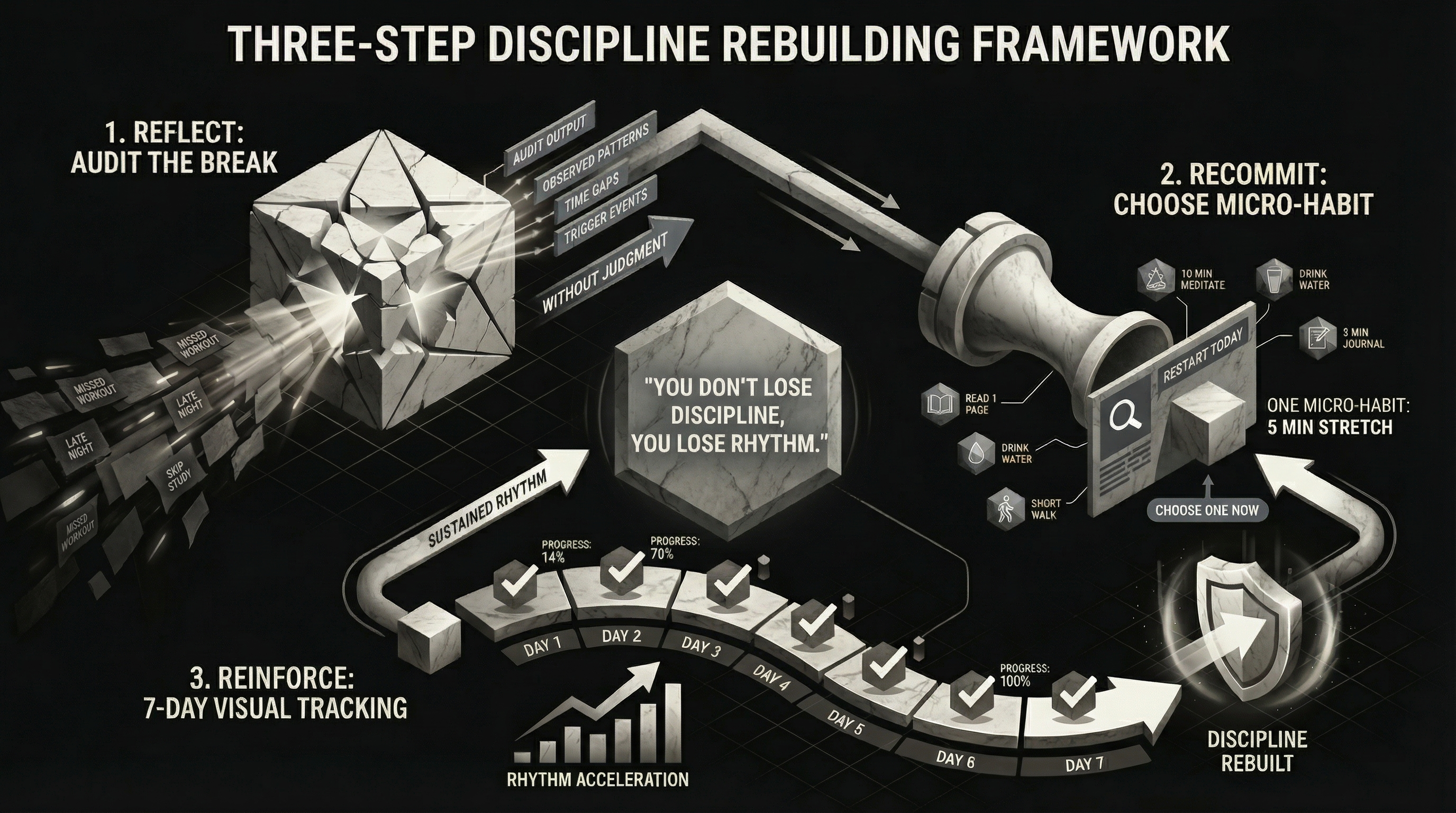
Table of Contents:
- Guilt is Wasted Energy
- Reset with Reason, Not Regret
- How to Rebuild Discipline After Losing Consistency
- Every Return is Evidence of Command
- Frequently Asked Questions
- Conclusion
Guilt is Wasted Energy
The crash after a broken streak is almost always emotional. Guilt floods in, telling you you’ve failed. Frustration follows close behind, whispering that all your hard work was for nothing. You feel like you’re right back at square one, and the mountain ahead looks impossible to climb again.
This is just an illusion. You’re not starting from zero. Every rep you did, every page you wrote, every healthy meal you ate built a foundation. That strength and experience don’t just vanish because you took a wrong turn. Guilt is the fog that keeps you from seeing the progress you already made.
The all-or-nothing thinking is a trap. It’s the voice that says, “Well, I already ate that cookie, so I might as well eat the whole box.” This kind of perfectionism is the biggest enemy of long-term goals. Clinging to perfection guarantees you’ll eventually quit — which is why building flexibility into your discipline matters. Accepting that setbacks happen is what keeps you in the game.
You don’t lose discipline — you lose rhythm.
The danger is real. When you let yourself feel bad long enough, you start believing you don’t have what it takes. Instead of restarting, you decide the habit wasn’t for you in the first place. You abandon the goal not because it was too hard, but because your perfect record was spoiled.
Reset with Reason, Not Regret
Most people treat a broken streak as a verdict. But the Stoics treated disruption as data — and that one shift changes everything about how fast you recover.
There’s a better way. Instead of drowning in regret, use the break as information. Look at the situation calmly and logically, without emotional baggage. Become a detective of your own behavior.
What did the break teach you? Maybe your routine was too rigid and didn’t allow for unexpected life events. Perhaps you weren’t getting enough sleep, which wrecked your willpower. The failure isn’t the lesson — understanding why it happened is. That setback clarifies what needs adjusting.
This process of review strengthens your focus for the next attempt. Each time you stumble and analyze the fall, you’re building a more resilient system. You’re learning your personal failure points and creating strategies to support them. You’re no longer just following a plan; you’re improving it with real-world data.
“The impediment to action advances action. What stands in the way becomes the way.”
— Marcus Aurelius, Meditations
The mistake is the way forward. The broken streak becomes the very thing that teaches you how to build an unbreakable one. Approaching setbacks this way turns a moment of weakness into a source of strength.
How to Rebuild Discipline After Losing Consistency
To move from regret to action, you need a simple, repeatable process — one that doesn’t ask you to summon motivation you don’t have. This three-step recovery process focuses on logic, small actions, and building proof to restore your confidence.
This won’t work if you try to sprint back to full intensity on Day 1. The framework only holds when you respect the on-ramp. Jump too fast and you’ll break again — harder, and with less faith in yourself than before.
Step 1: Reflect Without Judgment
Your first job is to understand the break, not punish yourself for it. Think of it like a mechanic looking at an engine — no blame, just a calm diagnosis of what went wrong. Set aside 10 minutes and get brutally honest without being unkind.
Ask direct questions. What was the exact moment the pattern broke? What was the trigger? Look at the context. Were you tired, hungry, stressed, or lonely? These internal and external states have a massive impact on willpower. As documented in research from the American Psychological Association, chronic stress significantly affects your brain’s executive functions, which govern self-control.
Was your environment working against you? If you’re trying to eat well but unhealthy food is everywhere in your kitchen, you’re making the task ten times harder. Identify the specific friction point. This isn’t about finding excuses — it’s about finding data you can use. That kind of honest self-assessment is a key part of staying in the discipline practice long-term.
Step 2: Recommit with One Small Task
Here’s where most people go wrong again. They try to jump right back into their full, intense routine — like trying to sprint a marathon when they’ve been on the couch for a week. Confidence is low, momentum is gone, and the pressure to be perfect again is immense.
Instead, your only goal for today is one ridiculously small win. The task should be so easy it feels almost silly not to do it. This single action signals to your brain that you’re back in control. It’s the first spark that starts rebuilding focus and momentum.
What does this look like? If you stopped going to the gym, your one task isn’t a full workout. It’s to put on your gym clothes. That’s it. If you broke your daily writing habit, write one sentence. If you fell off your eating plan, drink a glass of water right now.
This approach is powerful. You could also try habit stacking — attaching the new tiny habit to an existing one. “After I pour my morning coffee, I’ll open my journal.” This makes the behavior automatic over time without relying on willpower.
Step 3: Reinforce with Proof
Confidence doesn’t come from motivational quotes. It comes from keeping the promises you make to yourself. After a failure, trust in yourself is shaken. The final step is rebuilding that trust by creating a chain of undeniable proof.
For the next seven days, log your tiny win. Get a calendar or a notebook and put a big “X” on each day you complete your one small task. Don’t add more tasks. Don’t raise the stakes. The goal isn’t to return to your old performance level — it’s to build a new streak. A streak of showing up.
Research on habit formation shows that consistency is far more important than intensity at the start. A 2009 study found that the average time for a habit to become automatic was 66 days. Your seven-day proof cycle is the on-ramp back to that kind of consistency. It proves to yourself that you’re the kind of person who gets back on track.
Here’s how to apply the framework to different goals:
| Goal Area | Overwhelming Task | One Small Task (Step 2) | Reinforce with Proof (Step 3) |
|---|---|---|---|
| Physical Health | Complete a 1-hour workout. | Put on workout clothes. | Mark an ‘X’ on a calendar each day you do it. |
| Academic Success | Study for 3 hours straight. | Open your textbook to the correct page. | Check a box on your to-do list for 7 days. |
| Creative Work | Write 1,000 words. | Write one complete sentence. | Track your sentence streak in a journal. |
| Dietary Habits | Meal prep for the entire week. | Add one vegetable to your next meal. | Take a photo of the vegetable each day. |
Each small checkmark is a vote for the person you want to become. This is how momentum gets rebuilt.
Every Return is Evidence of Command
After a week of logging small wins, you’ll feel different. The guilt fades. A quiet sense of control replaces it. You realize the break didn’t define you — your response to the break did.
True discipline isn’t an unbroken chain of perfection. That’s a fragile, rigid state bound to shatter. Real discipline is measured by your re-align time: how fast you notice you’re off course and make a small correction. That’s a skill you can train like any muscle.
Let go of the fantasy of perfection. Embrace the cycle of effort, failure, and recovery. Each time you restart, you do so with more wisdom than before. You’re not starting over — you’re starting from experience. Your comeback is always stronger than your setback.
Don’t wait for Monday. Don’t wait until you “feel motivated.” That feeling follows action — it doesn’t precede it. Start now. Not perfectly, but with purpose.
Frequently Asked Questions
How long does it take for self-discipline to work?
There’s no set timeline. Building discipline is a continuous process, not a destination. With consistent practice of these principles, you’ll notice improvements in your focus and ability to stick to commitments. The key is consistent effort — it builds momentum over time.
What if I don’t feel motivated to even start small?
This is a common hurdle, and it’s precisely why the “one small task” approach works. Motivation often follows action, not the other way around. The goal is to make the initial step so easy that you don’t need motivation. Once you complete it, you often feel enough satisfaction to continue.
Can these principles help kids develop self-discipline?
Absolutely. Breaking tasks into small steps, tracking progress visually, and celebrating small wins are excellent strategies for children. It teaches them that progress — not perfection — is the goal. This framework helps them build resilience and a healthy relationship with their own goals.
Is it better to focus on one habit at a time?
Yes, especially when you’re recovering from a break. Trying to rebuild multiple habits at once is overwhelming and often leads to another failure. Master getting back on track with one specific goal first. Once that behavior feels more automatic, apply the same principles to another area.
Conclusion
The three-step recovery process works. Reflect without judgment, recommit with one small task, reinforce with proof — that’s the full structure. It doesn’t require motivation. It doesn’t require a perfect record. It requires showing up once, then again.
This only holds when you stop treating a missed day as a verdict. The framework breaks down the moment white-knuckling replaces the two-second pause to ask what actually went wrong.
Falling off doesn’t make you a failure. Coming back — again, and again, and again — makes you the kind of person discipline is built from.

Author
Master You
A practitioner of stoic discipline. Writing at the intersection of philosophy, hard work, and modern mastery.